

A delayed start carries long-run costs
Britain’s labour market challenge is increasingly being shaped not only by those who have already left the workforce, but by those who have yet to enter it. Around one in eight young people in the UK are currently not in employment, education or training (NEET), with the share rising steadily since the pandemic to reach 13.5% at the start of 2026.
The rise in young people outside work and education sits within a tougher UK labour market backdrop. Hiring has slowed amid higher costs, both from employment and other inputs, while research from the Department for Science, Innovation and Technology[1] show that growth in entry-level hiring has remained negative since late 2022. At the same time, more young people are citing health issues or disability as barriers to participation, while AI and automation add uncertainty over the future shape of entry-level work. Collectively, these factors point to a more difficult transition into the workplace.
The economic consequences can be long-lasting. Around three-fifths (62%) of NEETs aged 16 to 24 have never had a paid job, up roughly nine percentage points from a decade ago, covering an estimated 581,000 individuals. Entering adulthood without labour market experience means young people miss out on earnings, workplace skills and early-career progression.
To illustrate the scale of the economic opportunity at stake, Cebr estimates that delayed labour market entry until the age of 25 is associated with around £450,000 in forgone lifetime gross value added (GVA) per affected young person. This captures both the output not generated during the years spent outside work and the longer-term scarring effect of entering employment later, which can leave individuals on a lower earnings and productivity trajectory. At the aggregate level, the average cost across the full working-age lives of this NEET cohort is equivalent to £5.1 billion per year in forgone GVA.
Forgone GVA is not the only story. When young people are unable to enter work, the UK also forgoes the tax receipts linked to employment and spending. Cebr estimates that the associated fiscal tax loss from delayed workplace entry amongst NEETS amounts to £1.8 billion per year. This sits alongside wider pressures on the public purse, including higher spending on out-of-work, health and disability-related support where young people face barriers to entering employment.
Youth NEETs are part of Britain’s wider inactivity challenge.
The rise in NEETs matters not only because more young people are outside work and education, but because most are outside the labour force altogether. In Q1 2026, 60.5% of young NEETs were economically inactive, compared with 39.5% who were unemployed. This means that many are not just looking for work in a difficult jobs market, but they are facing barriers that prevent them from actively participating in the first place.
This links the youth NEET challenge directly to Britain’s broader inactivity problem. In the UK, around one in five UK working-age adults are currently outside the labour force, reducing the available workforce and weighing on growth, with consequences not only for the economy but also for living standards, health and social mobility. Moreover, this problem has worsened recently, with the UK being the only G7 economy to record higher inactivity since the pandemic.
This challenge is far from evenly distributed. Examining regional differences helps to identify where labour market challenges are most severe and where targeted interventions could deliver the greatest economic and social benefits.
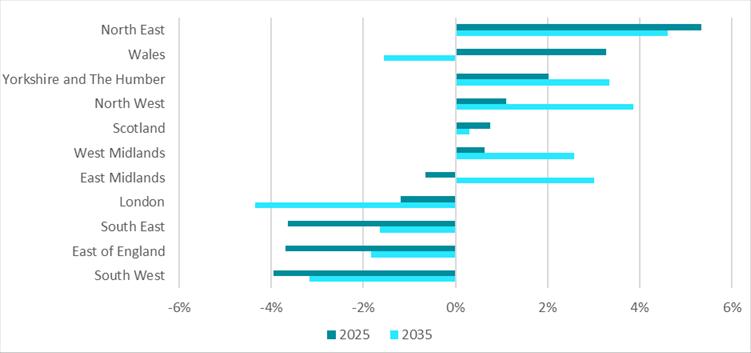
Some regions face substantially higher inactivity rates than others, creating markedly different labour market conditions across the country. In 2025, the North East is estimated to have the largest inactivity gap, the difference between a region’s inactivity rate and the GB average, with a reading of 26.9%. Wales also stands out, sitting 3.3 percentage points above the national figure, followed by Yorkshire & the Humber. By contrast, inactivity rates in the South of England sit below the GB average.
Figure 1. Estimated regional economic inactivity gaps relative to the GB average, 2025 and 2035
Source: ONS, Cebr Analysis
Looking ahead, the inactivity divide is set to persist. Cebr forecasts suggest that inactivity rates will improve across all regions over the next decade. However, the gap between the highest and lowest regional inactivity rates is forecast to remain wide at 9.0 percentage points by 2035. The North East is still expected to record the highest inactivity rate, while the East Midlands, the North West, and Yorkshire & the Humber are among those forecast to see their inactivity gaps worsen. Without stronger progress in regions where inactivity is most entrenched, falling national inactivity could mask a persistent regional divide in labour market participation.
This divergence likely reflects a combination of health, skills and local labour demand. Analysis by Health Equity North[2] finds that health-related economic inactivity is substantially higher in the North than in the rest of England, suggesting that weaker labour market participation in northern regions is not only a jobs-market issue but also reflects deeper health barriers. By contrast, London’s stronger concentration of high-productivity, high-skilled jobs means it is better placed to sustain lower inactivity. Over time, these regional advantages can compound, with stronger labour markets attracting more skilled workers while weaker areas face a smaller and less attached workforce.
The risk is that today’s youth detachment becomes tomorrow’s inactivity gap.
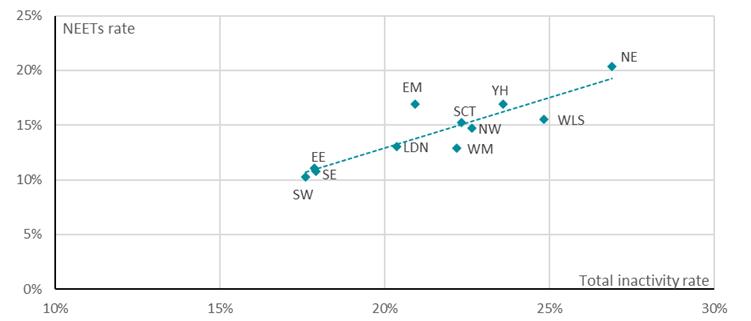
The regions forecast to remain under the greatest participation pressure are also among those with the highest current NEET rates. This matters because youth NEETs capture labour market barriers at the earliest stages of working life. Where young people struggle to enter work, training or further education, the effects may not only be felt today – they can shape skills, experience and labour market attachment for years to come.
Figure 2. Regional youth NEET rates vs. total inactivity rate, 2025[3]
Source: ONS, Cebr Analysis
The policy challenge is therefore twofold. There is a need to support those already outside the workforce, while strengthening routes into work, training and apprenticeships for young people in high-inactivity regions. Without stronger pathways, existing participation gaps may become harder to close.
The Government’s Youth Guarantee and Alan Milburn’s review of young people and work reflect a growing recognition that Britain’s participation challenge cannot be solved only by re-engaging adults who have already left the labour force. It also requires ensuring young people enter it successfully. For regions where inactivity is already entrenched, targeted support on skills, health barriers, early work experience, and the transition from education into employment could be central to breaking the cycle. Otherwise, today’s youth detachment risks becoming tomorrow’s inactivity gap.
[1] A snapshot of entry-level hiring in the UK
[2] Northern Health Science Alliance: Health for Wealth 2025
[3] Scotland’s 16-24 NEET rate is a modelled estimate, as directly comparable official statistics are no longer published.
For more information contact:
Alex Nairn, Economist
Email: anairn@cebr.com Phone: 020 7324 2872