

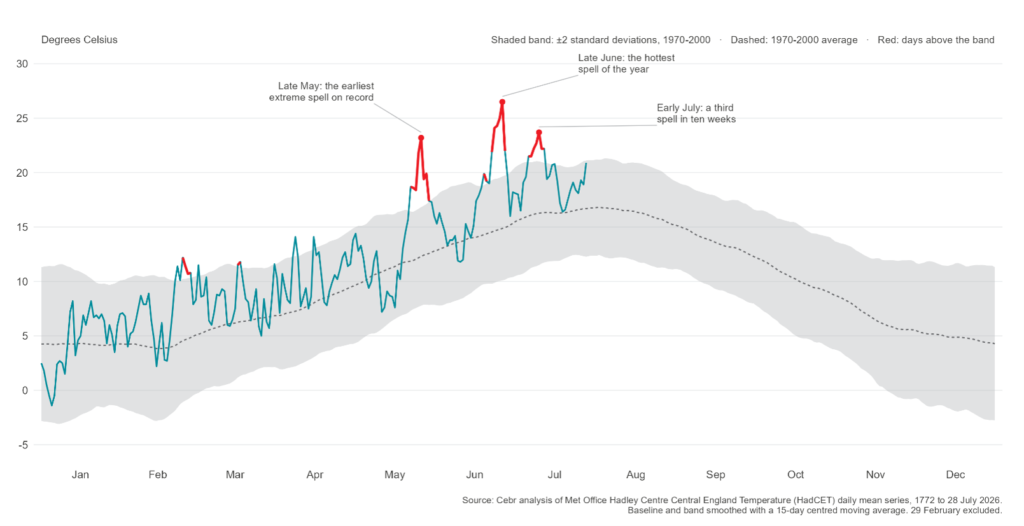
The UK has just lived through an extreme run of heat, recording its warmest June since the series began in 1884, and on 26th June 2026, the highest June temperature ever recorded in the UK, at 38.0 degrees Celsius.[1],[2] Daily temperatures have exceeded two standard deviations above the 1970 to 2000 norm on 35 days so far this year (as of 28th July), a threshold usually crossed only a handful of times a year, across three distinct spells in May, June and July.
Figure 1: Central England daily mean temperature in 2026, degrees Celsius
The natural question that follows is: what are the subsequent costs of extreme heat? Perhaps the obvious place to look is food. UK food and non-alcoholic beverage inflation stood at 1.7% in June, its lowest rate since August 2024, though this is a lagged reading that has yet to capture the full effects of recent shocks. Cebr modelling suggests that the commodity and input cost pressures navigating their way through the supply chain could add up to 1.1 percentage points to food inflation by mid-to-late next year, lifting it back above 3% and adding 0.12 percentage points to headline CPI.
That said, the source of the pressure matters. Roughly nine-tenths of the estimated effect stems not from the British summer, but from the escalation of conflict in the Middle East from February. That feeds through the food system in two ways.
The first is through global commodity prices, which began moving on energy costs well before the first heatwave arrived. The FAO Food Price Index rose by 5.4% between January and May, which aligns with the increase in energy costs linked to the conflict. The second channel is larger, but slower, coming through farm input costs. UK producer prices for fertilisers and nitrogen compounds are up 35% over the year and rose by almost a quarter between March and June alone. Fertiliser bought at those prices is likely to apply to crops harvested and sold months later. On our estimates, only half of that effect reaches consumers within ten months, and it is not fully transmitted until mid-to-late 2027. Against this, the direct contribution of this summer’s heat is modest. It accounts for less than a tenth of the total impact, equivalent to 0.11 percentage points on food inflation.
This minimal impact from heat can be attributed to the fact that British crops entered the summer in unusually good condition. The Agriculture and Horticulture Development Board (AHDB) rated 58% of UK winter wheat as good or excellent in late June, compared with 38% at the same point in 2025, while winter barley, oats and oilseed rape were all comfortably ahead of last year.[3] A mild winter and well timed June rainfall likely left the 2026 crop far better buffered against heat stress than the 2025 crop. This, however, comes with an important caveat. The AHDB assessment captured conditions up to 22nd June, immediately before the most intense spell of heat. AHDB also warned that late June temperatures may yet reduce yields by accelerating senescence and shortening the grain filling period. Even so, the evidence so far points to a limited food price effect due to the multiple heatwaves that have afflicted the UK.
The contrast with the Eurozone is telling, where extreme heat has been more damaging in countries such as France and Spain. Oxford Economics estimates that weather alone could add up to a full percentage point to food inflation there next year, lifting Eurozone food inflation to around 3% in 2027.[4] That the same summer produces such different outcomes either side of the Channel is in itself informative, reflecting the Eurozone’s status as a substantial agricultural producer absorbing a shock to its own supply, against the UK’s position as closer to a price taker on globally traded food.
That said, while the cost of this summer may not appear in prices, it is most definitely appearing in productivity. Cebr estimates that the late June heatwave cost the nine largest UK cities around £280 million in lost labour productivity in a single week, with almost £180 million of that concentrated in the City of London. Those cities account for only around 11% of the UK workforce, so naturally, the national figure will be materially larger. Rural England tells a similar story, with more than £50 million in forgone gross value added across rural local authorities between 22nd and 26th June alone.
Independent work by the Grantham Research Institute on Climate Change and the Environment at the London School of Economics and Political Science (LSE) and the Euro Mediterranean Center on Climate Change puts the national cost of the same week in excess of £1 billion and 24 million lost working hours.[5]
Of course, the dynamics of the costs covered are vastly different. A tenth of a percentage point on food inflation is spread thinly across households and fades within a year as base effects wash through. On the other hand, output lost to a week of extreme heat is unrecoverable, nor is it evenly distributed. Indeed, its incidence is likely on a narrower group, with the LSE reporting a significant share of workers (3.6%) who could not work at all during the June heatwaves.[6] These workers are likely to be concentrated in outdoor and physically demanding occupations such as construction and agriculture, some of which are amongst the lowest paid. They are also more likely to be paid by the hour or through self-employment than on a salary, so time not worked is income not earned rather than a cost absorbed by the employer. In turn, extreme heat has shown the potential to be regressive, with its effects felt through pay packets as much as prices.
As summers like this move from anomaly to expectation, the binding constraint will not be the resilience of any single supply chain, but the adaptability of the UK’s workplaces, buildings and working practices. That makes extreme heat a living standards issue as much as a climate one. On the evidence of this summer, households will barely notice the heat at the till. Rather, they are far more likely to feel it in their pay packets, and that is by some distance the more damaging of the two.
For more information contact:
Pushpin Singh, Managing Economist, psingh@cebr.com
Dan Smith, Economist, dsmith@cebr.com
[6] ibid