

Britain’s Anchor Economies: A framework for identifying hidden engines of regional growth
Regional growth is central to the UK’s policy agenda, with continued efforts to close the North–South divide and an emphasis on greater devolved powers to local leaders. Yet beneath the UK’s broad regional divides lies a more complex picture of local economic strengths and opportunities for growth.
By identifying Britain’s Anchor Economies at the local authority level, our research with HSBC UK highlights areas that could act as engines of regional prosperity, identifying where existing economic potential can be harnessed and where targeted investment and policy support could drive wider economic growth.
What makes an Anchor Economy?
Large businesses play a disproportionate role in the UK economy. They make up just 0.1% of UK firms, yet they account for an estimated 40% of private sector employment and nearly half of turnover. Their influence extends well beyond their own operations, supporting local jobs and smaller businesses along the supply chains.
But Anchor Economies are about more than just large employers. Many are characterised by sector specialisation, where clusters of related businesses and expertise develop around established industries. They also serve as important regional employment hubs, drawing workers from surrounding areas. However, a strong corporate presence alone does not guarantee long-term prosperity. Wider economic conditions, from workforce skills to household incomes, also shape local resilience and the capacity to thrive.
Our research therefore measures local economies on two dimensions, each captured in its own index. The Anchor Economy Index measures how strongly a local economy is anchored by large employers, sector specialisation and inward commuting, while the Resilience Index assesses the wider conditions that support local prosperity including household incomes, workforce skills and long-run economic growth. Examining these dimensions together helps to build a detailed picture for local economic development, reflecting different conditions and opportunities across Britain.
Comparing each local authority against the national average on both indices gives us four types of local economy: Resilient Anchor Economies, combining a strong corporate presence with favourable economic conditions; Developing Anchor Economies, where strong anchor characteristics are accompanied by greater scope to build economic resilience; Broad-Based Economies, where underlying conditions are strong, but anchor characteristics are less pronounced; and Emerging Economies, where there is scope to strengthen both dimensions.
The framework in practice
Together, Britain’s Anchor Economies employ over 17 million people and generate £1.4 trillion in economic output. While London dominates the rankings, Anchor Economies extend far beyond the capital. In fact, 68% are located outside London and the South East.
There is no one-size-fits-all approach to local economic growth. By grouping local authorities into four distinct types of economy, our framework helps identify shared characteristics and potential priorities for investment and policy support. The contrasting cases of Warwick and Crawley illustrate what this means in practice.
Warwick: Harnessing the potential of an established employment hub
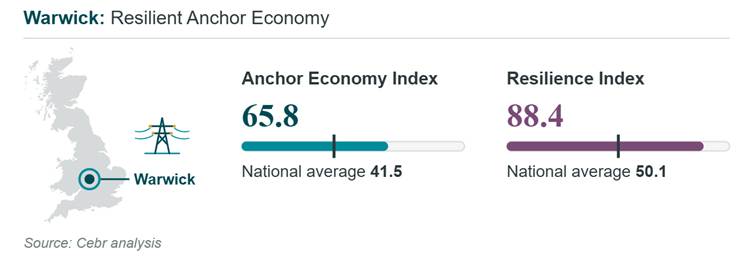
Warwick stands out as Britain’s most resilient Anchor Economy outside London, with a Resilience Index score of 88.4. Home to a high concentration of large employers, including National Grid, Warwick has a specialised economy and is an important employment hub, attracting workers from surrounding areas.
This corporate strength is matched by strong economic foundations. Disposable income per head is 37% above the West Midlands average, while the local economy has grown by an average of 3.3% annually over the past decade. Major employers also support skills development, with National Grid announcing plans in 2022 to recruit over 2,300 graduates and apprentices over five years.[1]
For Warwick, the opportunity lies in building on existing strengths. Continued investment in energy infrastructure, skills development and building stronger links with regional supply chains could help sustain its competitiveness and extend the benefits of growth across the wider West Midlands.
Crawley: Strengthening resilience in a highly specialised economy
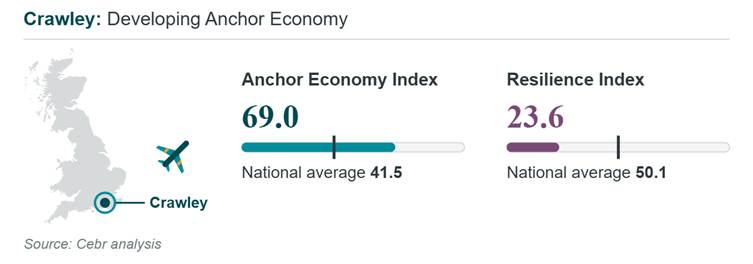
Crawley is a clear example of a Developing Anchor Economy, combining an established corporate presence with scope to strengthen its wider economic foundations. Home to Gatwick Airport and the Manor Royal Business District, it ranks among Britain’s top 10 local authorities for its concentration of large businesses. Yet while Crawley scores highly on the Anchor Economy Index (69.0), its Resilience Index score is considerably lower (23.6).
With around a fifth of local output generated by transport and storage, Crawley’s reliance on aviation and related industries became evident during the pandemic. As air travel collapsed, the local economy suffered a sharp contraction, highlighting how sectoral specialisation, while supporting local economic activity, can leave economies more vulnerable to industry-specific shocks.
For Crawley, the opportunity may lie in strengthening resilience while building on its established corporate base. Developing local skills, widening access to higher-value employment and encouraging investment in complementary sectors could help diversify economic activity and improve its ability to withstand and adapt to future shocks, while retaining the benefits of its existing specialisation.
Looking beyond Britain’s Anchor Economies
Under our framework, not every area is classified as an Anchor Economy, yet there are still distinct opportunities for local growth. York, for example, is classified as a Broad-Based Economy, with strong underlying economic foundations that could help attract additional large employers and support the development of specialist business clusters. Bradford, by contrast, is classified as an Emerging Economy, where strengthening skills, infrastructure and the wider conditions for investment could help create a stronger foundation for future growth.
Concluding thoughts
As UK policy brings greater focus to locally driven economic development, understanding the characteristics of Britain’s local economies is increasingly important. Rather than offering a simple ranking, our framework provides a basis for considering how investment and policy priorities might differ across places, from supporting established employment hubs to creating the conditions for new business activity.
Ultimately, unlocking wider regional prosperity means looking beyond the familiar economic divides and recognising how each local area’s strengths and position create distinct opportunities for growth. Read the full report on Britain’s Anchor Economies here.