

Recent economic growth outturns have surprised to the upside, but with earnings growth moderating and inflation rising sharply, most UK households are unlikely to have seen a meaningful improvement in living standards.
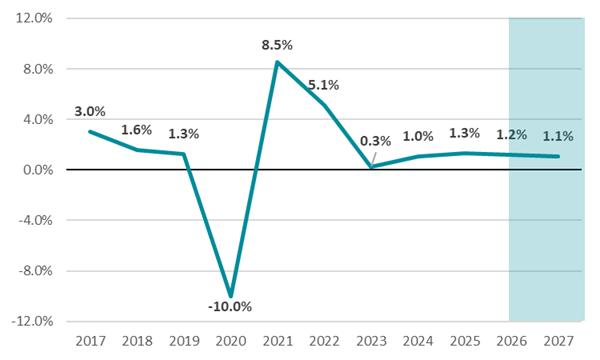
The UK economy has so far outperformed expectations in 2026, particularly given the headwind posed by the war in Iran. Real GDP grew by 0.4% in Q2, with similar growth estimated for the three months to July. This has predominantly been supported by strong services growth, partially attributable to developments in artificial intelligence (AI).
Stronger-than-anticipated outturns have prompted the OECD to upgrade its 2026 UK growth forecast from 0.9% to 1.1%. This moves it closer to Cebr’s own forecast of 1.2% this year. That said, we anticipate that the demonstrated resilience will falter in 2027, with growth forecast to slow to 1.1%, slightly above the OECD’s new forecast of 1.0%.
Figure 1 – UK real GDP growth, annual % change, 2017-2027 (2026-2027 forecast)
Source: ONS, Cebr analysis
Recent comparisons with the G7 also demonstrate a relative improvement in economic performance. The UK was the fastest-growing economy in the G7 in Q1, though this may in part reflect some seasonality in data collection. It fell only to a joint second in Q2, level with the US and behind Canada. This is positive news for an economy whose growth rate was second from bottom as recently as Q4 2023. Even the UK’s long-decried investment woes appear to be easing. Growth in gross fixed capital formation since 2019 ranks third in the G7, behind only Italy and the US. While long overdue, economic growth in the UK is showing signs of resilience at the most unlikely of moments.
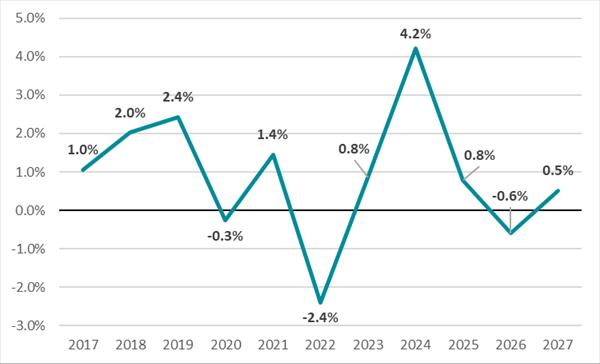
UK households can be forgiven for not jumping for joy, with stronger outturns being a long way from showing up in household budgets. Amidst falling vacancies and declining numbers of payrolled employees, annual real earnings growth fell back below 1.0% in the three months to July, and this remains propped up by the public sector. Cebr also expects real disposable incomes to fall by 0.6% this year, their first annual decline since 2022. Therefore, while growth demonstrates resilience, household financial security is deteriorating.
Figure 2 – UK real disposable income growth, annual % change, 2017-2027 (2026-2027 forecast)
Source: ONS, Cebr analysis
There are two key influences on the slowdown in real earnings growth, with the first being the UK’s underperforming labour market. Arguments diverge as to whether this is the product of policy factors or technological advancement. The hike to employers’ National Insurance Contributions in 2025 and above-inflation hikes to the National Living Wage can be identified as drivers of reduced hiring demand and falling numbers of payrolled employees, particularly in the retail and hospitality sectors. That said, others will argue that weaker hiring has been predominantly driven by an increased demand for AI to replace workforce roles in the sectors that are driving growth forward. The truth likely lies somewhere in between. AI has been linked to a fall in job postings for exposed roles, although proving that these were caused by AI and not by other factors is difficult. Either way, firms would likely be less driven to seek such efficiencies if the alternative wasn’t so expensive.
The second key influence is inflation, which is currently well above target and accelerating. This was arguably the main driver of the drop-off in real earnings growth in July, with the introduction of the new energy price cap causing inflation to rise to 2.9%, up from 2.6% in June. It has since accelerated further to 3.1% in August, driven primarily by renewed pressures on vehicle fuels. Overall, we expect CPI inflation to come in at 3.1% for 2026. What’s worse for real earnings is that the Bank of England is closely monitoring for evidence of second-round inflationary impacts from the war in Iran, meaning that any improvements in nominal wage growth are likely to be met with a hike in interest rates, which may then rein in any further improvements. UK workers will therefore be relying on slowing inflation to drive real earnings growth, something that is not anticipated until well into 2027.
Economic growth has outperformed expectations, but this will mean very little for UK households if its effects do not translate to wages. It is also likely to be dampened if miserly earnings growth eats into growth in domestic consumption. In the October Budget, Chancellor John Healey would do well to prioritise bridging the gap between the growth seen on the news and the growth felt in wallets.
For more information contact:
Dan Smith, Economist, dsmith@cebr.com